MRR vs ARR: Which Should You Track?
MRR and ARR are the same metric in different units, but the choice of which to report changes how your team thinks. Here is when to use each, and the math for translating between them.
- 1. Definitions
- 2. The math is the same, but the framing changes behavior
- 3. When to switch
- 4. The components of MRR (worth tracking every month, regardless)
- 5. Common mistakes when computing MRR/ARR
- 6. A worked example
- 7. Quick benchmarks to know
- Next steps
- Run the numbers
MRR (Monthly Recurring Revenue) and ARR (Annual Recurring Revenue) are the same number multiplied by 12. The reason both exist is purely cultural: small SaaS reports in MRR because the monthly delta is meaningful, large SaaS reports in ARR because the annual number sounds more impressive to the board and to investors. The right answer for your business depends mostly on size. Here is when to switch, why it matters, and how to project both with the MRR/ARR Projection Calculator.
The rule of thumb: Use MRR while it's still measured in thousands. Switch to ARR once you cross roughly $1M ARR.
1. Definitions
MRR = the normalized monthly recurring revenue from all active subscriptions, as of a specific date.
MRR = Σ (subscription value normalized to monthly)
A customer on a $1,200/year annual plan contributes $100/month to MRR. A customer on a $99/month plan contributes $99/month. Add them up across your customer base.
ARR = MRR × 12. That's literally it. ARR is just MRR expressed annually.
2. The math is the same, but the framing changes behavior
Both metrics compute the same underlying number, but reporting in MRR vs ARR subtly shifts how a team thinks:
| MRR-mindset team | ARR-mindset team | |
|---|---|---|
| Weekly standup | Talks about Net New MRR | Talks about pipeline |
| Forecasting horizon | Next 3–6 months | Next 4 quarters |
| Customer profile | Self-serve, SMB | Sales-led, mid-market+ |
| Typical deal size | $50–$500/mo | $20K–$200K/year |
| Investor conversation | "We're at $40K MRR" | "We're at $5M ARR" |
Neither is right or wrong, but they imply different operating cadences.
3. When to switch
Most SaaS companies switch from MRR to ARR somewhere between $500K and $2M ARR. The trigger is usually one of:
- The board starts referring to numbers in ARR
- Annual contracts become >50% of new bookings
- The monthly delta becomes small relative to the total (< 2% MoM)
- You are raising a Series A and the deck conventions are ARR
There is no rule against tracking both internally forever — most companies do. But your public-facing single number gradually becomes ARR as you scale.
4. The components of MRR (worth tracking every month, regardless)
Whether you headline MRR or ARR, you must decompose the movement into its components every period:
| Component | Description |
|---|---|
| Starting MRR | The number you ended last month with |
| + New MRR | From customers who didn't exist last month |
| + Expansion MRR | From existing customers upgrading or adding seats |
| − Contraction MRR | From downgrades |
| − Churned MRR | From cancellations |
| = Ending MRR | This month's number |
The trajectory of each line tells you something specific about the health of the business — and a single aggregate MRR or ARR hides all of it.
5. Common mistakes when computing MRR/ARR
- Including one-time fees — implementation, training, setup. These are revenue, but not recurring. Keep separate.
- Including overage charges — usage-based overages are revenue but are not recurring at a predictable level. Separate.
- Counting contract bookings instead of activated revenue — a $120K annual contract signed today but starting next month is bookings, not ARR, until it activates.
- Including trials — trials are zero MRR until they convert to paid.
- Mis-handling discounts — MRR should be net of discount. A "$1,200/year" plan sold at a $200 discount contributes $1,000/12 = $83.33 to MRR.
6. A worked example
Last month you ended at $48,000 MRR. This month:
- 12 new customers averaging $150/mo each: +$1,800 New MRR
- 5 existing customers upgraded for a total of +$650: Expansion MRR
- 2 existing customers downgraded for −$200: Contraction MRR
- 3 customers cancelled for −$420: Churned MRR
Ending MRR = $48,000 + $1,800 + $650 − $200 − $420 = $49,830
Net New MRR = $1,800 + $650 − $200 − $420 = $1,830
ARR = $49,830 × 12 = $597,960
That's a 3.8% MoM growth, which annualizes to ~57% — solid for a sub-$1M company.
7. Quick benchmarks to know
- Healthy early-stage SMB SaaS grows MRR 10–20% MoM (200%+ ARR YoY)
- Healthy Series A grows 8–12% MoM
- Healthy Series B grows 5–8% MoM
- Public SaaS averages 25–40% ARR YoY
The numbers compound, so high MoM rates do not last forever. Going from 15% MoM to 5% MoM is not "decline" — it's normal scale.
Next steps
Two concrete actions:
- Build a 12-month MRR/ARR projection in the MRR/ARR Projection Calculator, with realistic New, Expansion, and Churn assumptions.
- Test sensitivity to churn — drop churn from 4% to 2% in the Churn Rate Calculator and re-run the projection. You will see why churn dominates ARR growth at scale.
Then decide: are you an MRR-team or an ARR-team this quarter? Pick one for external reporting and stay consistent for the next 4 quarters minimum.
Run the numbers
Everything below came out of this site's own MRR / ARR Projection Calculator. The figures are not quoted from anywhere else: each row is one run of the same calculation the tool page performs, using August 2026 rules. Put the same inputs in and you will get the same output.
How the result moves with current mrr
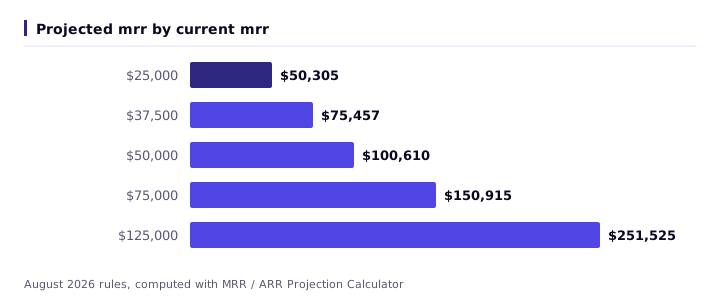
We ran 5 values of current mrr through the calculator and left every other input at its default. As of August 2026, the output was:
| Current mrr ($) | Projected mrr ($) | Projected arr ($) |
|---|---|---|
| 25,000 | 50,304.91 | 603,658.94 |
| 37,500 | 75,457.37 | 905,488.41 |
| 50,000 | 100,609.82 | 1,207,317.88 |
| 75,000 | 150,914.74 | 1,810,976.82 |
| 125,000 | 251,524.56 | 3,018,294.71 |
Running current mrr from $25,000 up to $125,000 moves projected mrr from $50,305 to $251,525 — a spread of $201,220. That gap is the part a single headline rate never shows.
The same runs seen through projected arr
At $25,000, projected arr works out to $603,659; at $125,000 it is $3,018,295. Looking only at projected mrr tends to understate how much the outcome shifts across that range.

Assumptions behind these figures
| Input | Value |
|---|---|
| Current mrr | $50,000 |
| Growth rate | 8% |
| Churn rate | 2% |
| Months | 12 months |
| As of | August 2026 |
| Method | identical to /tools/mrr-arr-projection-calculator |
Rates, thresholds and defaults change over time, so treat these as August 2026 figures under the 2026 rule set. For your own situation, open the MRR / ARR Projection Calculator and enter your real numbers — the calculator runs the same code that produced every figure on this page.
Frequently Asked Questions
What's the difference between MRR and ARR?
MRR (Monthly Recurring Revenue) and ARR (Annual Recurring Revenue) represent the same underlying number, just expressed differently — ARR is simply MRR multiplied by 12. Smaller SaaS companies tend to report in MRR because the monthly change is more meaningful relative to the total, while larger companies switch to ARR because it reads as a more impressive headline figure to boards and investors.
When should a SaaS company switch from reporting MRR to ARR?
Most companies make the switch somewhere between roughly $500K and $2M in ARR, often triggered by the board starting to speak in ARR terms, annual contracts becoming the majority of new bookings, or the monthly change becoming small relative to the total base. Many companies continue tracking both internally even after their external headline number shifts to ARR.
What are the components of MRR movement?
Every period's MRR change breaks down into new MRR from new customers, expansion MRR from existing customers upgrading or adding seats, contraction MRR from downgrades, and churned MRR from cancellations. Reporting the aggregate MRR or ARR number alone hides the story told by each of these individual components.
What common mistakes happen when calculating MRR?
Frequent errors include counting one-time fees like setup or implementation charges as if they were recurring, including usage-based overage charges that aren't predictable, counting signed contract bookings before the revenue actually activates, including trial users who haven't converted, and failing to net discounts out of the MRR figure. Any of these can make a company's growth rate look stronger than the underlying recurring revenue actually supports.
Calculators referenced in this guide
Keep reading
Cap Table 101 for Founders
Your cap table is the single source of truth for ownership. Learn how dilution works, common term sheet pitfalls, and how to model future rounds.
SaaS Valuation Methods Explained
How investors value SaaS companies in 2026 — revenue multiples, the Rule of 40, DCF, and what the numbers actually mean for founders.
Conversion Rate Optimization Math
CRO is statistics, not vibes. Learn the math behind sample sizes, statistical significance, and how to read A/B test results without fooling yourself.
Business & SaaS Disclaimer
This article is for educational purposes. Actual business performance varies based on many factors. SaaSCalcHub is not business or financial advice. Consult business advisors, CPAs, and consultants for your specific situation.
Last updated: Oct 24, 2026